
Staple foods are regularly eaten foods that supply a substantial share of a community’s calories and are commonly available, affordable, and culturally familiar. Their preparation styles, however, vary dramatically: rice may be steamed, fermented, puffed, or pressed; maize may be boiled, ground, or treated with an alkaline solution; potatoes may be baked, dried, mashed, or fermented; and cassava may be grated, detoxified, dried, or turned into fermented dough. This diversity matters because cereals, roots, and tubers remain central to global food security: the Food and Agriculture Organization of the United Nations (FAO) reports that cereals provide roughly half of the world’s food energy, while rice alone supplies about one-fifth of human dietary energy worldwide. Shared staples therefore reveal how technology, climate, nutrition, and culture shape what appears to be the same food.
Staples—Preparation Styles Define How Common Foods Change
The pairing “staples—preparation styles” describes the relationship between a foundational food and the physical, chemical, or biological processes used to make it edible, digestible, storable, or culturally appropriate. Food historian Sidney W. Mintz’s work on food and culture emphasizes that ingredients acquire social meaning through labor, trade, and repeated patterns of use; a staple is therefore not defined only by its plant species but also by the methods communities use to transform it.
The main hyponyms of this pairing include thermal preparation, mechanical transformation, fermentation, alkaline processing, drying, and preservation. These categories often overlap. Maize can be nixtamalized and then ground into dough; rice can be steamed and later fermented; cassava can be grated, pressed, fermented, and toasted. A preparation style may improve safety, extend shelf life, change texture, or make nutrients more available.
A useful comparison chart would place each staple on one axis and the main transformation on the other: rice—steaming and fermentation; maize—alkaline cooking and grinding; wheat—milling and baking; potato—boiling, baking, or freezing; cassava—detoxification and drying. The chart would show that “cooking” is not a single universal action but a collection of solutions to local environmental and nutritional problems.
Thermal Preparation: Steaming, Boiling, Baking, and Roasting
Thermal preparation uses heat to soften starch, improve flavor, and reduce some food-safety risks. Steaming preserves the shape of rice grains and is central to dishes such as South Asian rice, Chinese zhengfan, and West African rice preparations. Boiling produces porridge or soft grains, while dry heat creates the crust and aroma associated with bread, roasted maize, and baked potatoes.
Potatoes demonstrate how one staple can occupy opposite culinary categories. The same tuber may be boiled and mashed, baked whole, sliced and fried, frozen for industrial processing, or dried into flakes. The U.S. Department of Agriculture identifies potatoes as a major source of carbohydrate and also notes their contribution of potassium and vitamin C, although preparation method strongly affects energy density: frying generally adds considerably more fat than boiling or baking.
Heat also controls texture through starch gelatinization. When rice, wheat, or potatoes absorb water and reach sufficient temperatures, starch granules swell and become more digestible. This explains why a raw grain, a steamed grain, and a baked flour product can have very different textures even when they originate from closely related carbohydrate structures.
Mechanical Transformation: Milling, Grinding, Pounding, and Pressing
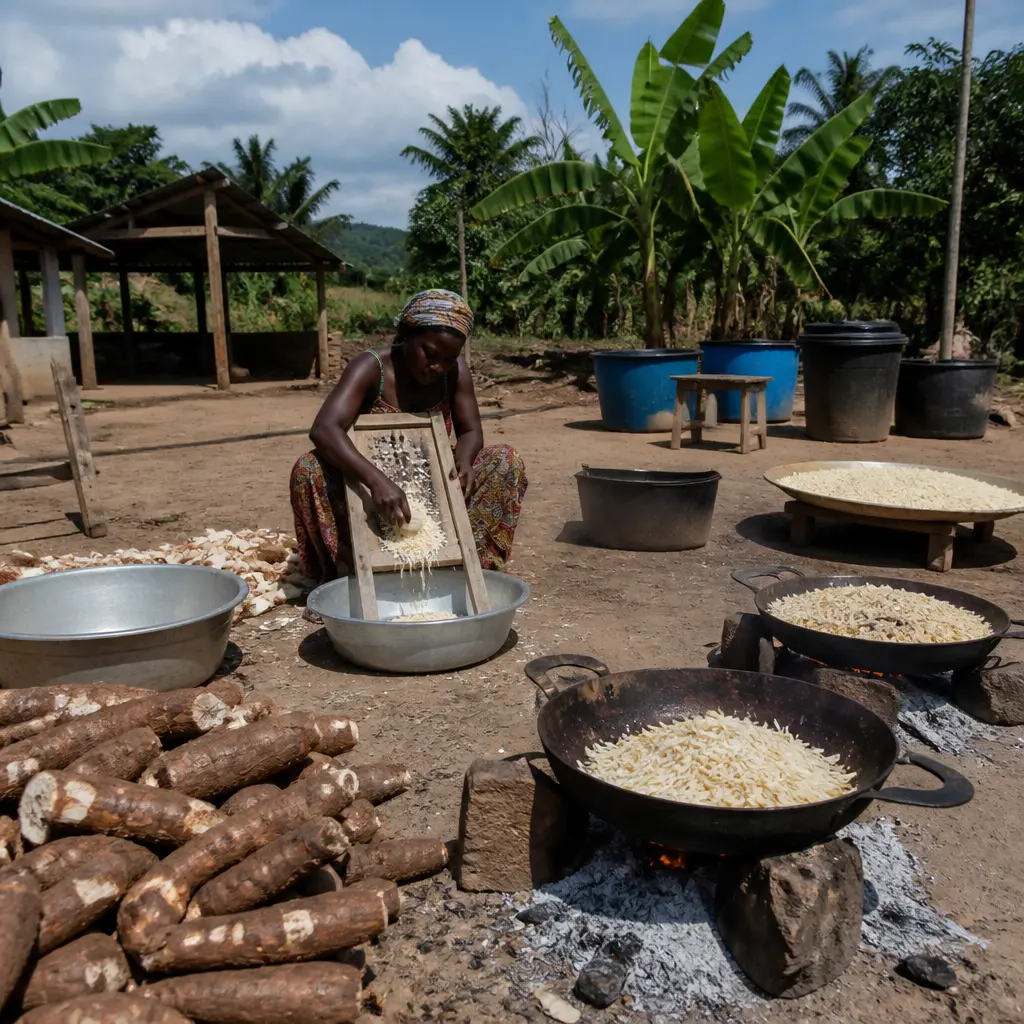
Mechanical preparation changes a staple without necessarily changing its chemical identity. Milling wheat into flour enables leavened bread, noodles, and pastry; pounding rice or millet produces meal; grinding maize creates dough or porridge; and pressing cassava removes liquid before drying or toasting. These techniques reduce particle size, alter cooking time, and allow food to be shaped into portable or storable forms.
Wheat offers an especially broad set of mechanical styles. Whole wheat can be boiled as berries, cracked into bulgur, rolled into flakes, milled into flour, or stretched into noodles. The International Wheat and Maize Improvement Center notes that wheat is grown across diverse environments, helping explain why it supports flatbreads, leavened loaves, steamed breads, pasta, and couscous-like products in different regions.
Mechanical processing can also separate nutritional components. Refining commonly removes some bran and germ from grains, producing a smoother flour but reducing naturally occurring fiber and micronutrients. Enrichment and fortification programs partly address these losses; the World Health Organization identifies fortification of staple foods as a population-level strategy for reducing deficiencies when diets are otherwise limited.
Staples—Fermentation Styles Create Preservation and Flavor
Fermentation is a biological preparation style in which microorganisms transform sugars and other compounds into acids, gases, or alcohols. In staple foods, fermentation can lower pH, produce distinctive aromas, soften plant tissues, and extend storage life. It may also reduce certain antinutritional compounds and make a food easier to digest, although its nutritional effect depends on the organism, time, temperature, and later cooking.
Fermented Rice: From Grain to Batter, Cake, or Beverage
Rice is often imagined as a plain steamed grain, yet fermentation creates a different category of staple food. In South India, fermented rice-and-legume batter becomes idli or dosa; in parts of East and Southeast Asia, rice supports alcoholic beverages, vinegars, and fermented cakes. The batter’s microorganisms produce acids and gases that influence flavor, tenderness, and aroma.
The FAO describes rice as one of the world’s most important food crops, cultivated in more than one hundred countries. Its broad geographic reach helps explain the large number of preparation styles: steaming suits intact grains, milling supports flour and noodles, and fermentation creates products that can be served at different stages of a meal.
Fermented Cassava: A Safety Process as Well as a Culinary Choice
Cassava illustrates why preparation methods can be essential for safety. Some cassava varieties contain cyanogenic compounds that can release hydrogen cyanide when plant tissues are damaged. Traditional processing may combine peeling, grating, soaking, fermentation, pressing, drying, and roasting. Products such as gari, fufu, and fermented cassava dough therefore represent carefully developed processing systems rather than simple variations in taste.
The FAO and the World Health Organization have documented cassava’s importance in tropical food systems and the need for adequate processing. Cassava is especially valuable because it tolerates drought and poor soils, but its benefits depend on correct preparation. This is a clear example of a staple’s preparation style functioning as a food-security technology.
Staples—Chemical Preparation Styles Improve Nutrition and Usability
Nixtamalized Maize: Alkaline Cooking with Nutritional Consequences
Nixtamalization is the cooking and soaking of maize in an alkaline solution, traditionally made with lime or wood ash. The process loosens the hull, softens the kernel, improves grinding, and contributes calcium to the resulting dough. It also helps make niacin more biologically available, reducing the risk of pellagra in diets heavily dependent on untreated maize.
The term comes from Nahuatl and is associated with long-established Mesoamerican food systems. Tortillas, tamales, and masa-based dishes depend on this transformation. The process shows why a staple cannot be evaluated only in its raw form: the nutritional value available to consumers may depend on a culturally inherited chemical treatment.
Sprouting, Soaking, and Other Less Visible Transformations
Soaking and sprouting alter grains and legumes through water uptake and enzymatic activity. Sprouted grains may develop sweeter flavors as enzymes break down stored starch, while soaking legumes can shorten cooking time and reduce some compounds associated with poor mineral absorption. These methods are less visually dramatic than baking or frying, but they can change texture, digestibility, and preparation efficiency.
The Harvard T.H. Chan School of Public Health emphasizes that dietary quality depends on the whole food pattern, not one processing label alone. A minimally processed staple can still be served with little nutritional variety, while a processed staple may be part of a balanced meal. The relevant question is what the preparation adds, removes, or makes available.
Staples—Preparation Styles Reflect Climate, Labor, and Culture
Preparation styles often solve local storage problems. Drying protects maize, wheat, cassava, and potatoes from spoilage; fermentation can preserve wet crops; and milling can turn a harvest into transportable flour. In areas with limited fuel, soaking, pressure cooking, or milling may reduce cooking time. In humid regions, fermentation and roasting can help manage seasonal abundance.
Cultural identity also shapes which form of a staple is considered complete. A wheat grain may become bread in one society and noodles in another; maize may become tortillas, polenta, pap, or fermented beverage; rice may be eaten sticky, dry, puffed, sour, or sweet. These are not merely culinary preferences. They encode histories of migration, trade, agriculture, religion, and household labor.
The broader food-system implication is significant. FAO data show that a small group of crops supplies a very large share of global calories, creating vulnerability when production, prices, or climate conditions change. Preserving diverse preparation knowledge can increase resilience by allowing communities to store, detoxify, diversify, and reuse staple crops in more than one form.
Conclusion: Shared Staples—Preparation Styles Reveal Hidden Food Technologies
Shared staples are not uniform foods. Thermal methods turn grains and tubers into soft, crisp, roasted, or baked dishes; mechanical methods convert them into flour, meal, noodles, and dough; fermentation produces preservation, flavor, and texture; and chemical processes such as nixtamalization can improve safety and nutrient availability. Rice, maize, wheat, potatoes, and cassava demonstrate how one crop can support radically different food traditions.
Understanding these preparation styles is important for nutrition policy, climate adaptation, culinary education, and food heritage. Readers can explore the topic further by comparing one staple across several regions, examining how processing changes its nutrient profile, and learning which traditional methods are essential for safety. The next time a familiar grain or root appears on a plate, its preparation history may be as important as the crop itself.
Sources: Food and Agriculture Organization of the United Nations, Rice and rice-based food systems, https://www.fao.org/rice/en/; Food and Agriculture Organization of the United Nations, Crop Prospects and Food Situation, https://www.fao.org/giews/reports/crop-prospects/en/; World Health Organization, Food fortification, https://www.who.int/health-topics/food-fortification; World Health Organization, Cyanogenic glycosides, https://www.who.int/publications/i/item/9241572405; U.S. Department of Agriculture, FoodData Central, https://fdc.nal.usda.gov/; Harvard T.H. Chan School of Public Health, The Nutrition Source, https://nutritionsource.hsph.harvard.edu/; International Wheat and Maize Improvement Center, Wheat, https://www.cimmyt.org/work/wheat/; Sidney W. Mintz, Sweetness and Power: The Place of Sugar in Modern History, Penguin Books, https://www.penguinrandomhouse.com/books/159395/sweetness-and-power-by-sidney-w-mintz/