

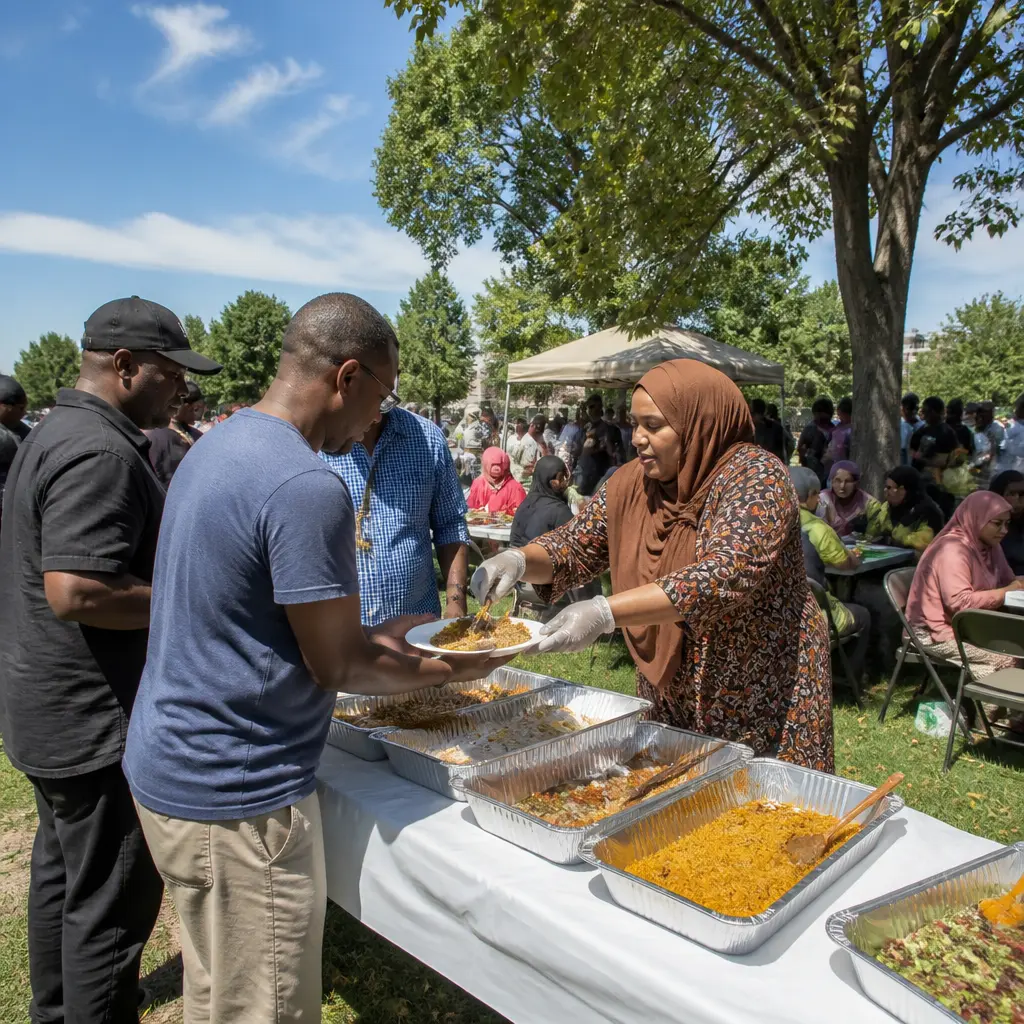
Abundant servings are more than generous portions of food: they are a social signal that says there is enough for everyone, including the person who has just arrived. In this article, Abundant Servings–Social Abundance describes the ability of plentiful, shared food to create welcome, reciprocity, and temporary kinship among people who may not know one another. Anthropologist Mary Douglas treated the meal as a structured social event, while sociologist Georg Simmel argued that eating together transforms nourishment into sociability. The evidence is relevant because the United States Department of Agriculture reported that 13.5 percent of U.S. households experienced food insecurity in 2023, and the U.S. Surgeon General has identified social disconnection as a serious public-health concern. From family-style dinners and potlucks to community kitchens and holiday feasts, abundant servings can reduce social distance by giving strangers a practical reason to sit down, contribute, converse, and belong.
Creates belonging: Abundant Servings–Social Abundance
Abundant Servings–Social Abundance is the relationship between plentiful shared food and the perception that a group has room, resources, and goodwill to include others. It does not require luxury. A large pot of soup, an overflowing rice dish, a basket of bread, or a table covered with homemade desserts can communicate generosity more powerfully than an expensive individual plate.
The pairing works through several connected characteristics. First, abundance lowers the fear of scarcity: guests do not feel that their presence will deprive someone else. Second, serving food creates a low-pressure exchange. A person can pass a bowl, refill a glass, ask about a recipe, or offer help without immediately disclosing personal history. Third, a shared table establishes temporary equality because participants perform the same basic actions—sitting, serving, eating, and thanking one another.
Communal eating as social infrastructure
Communal eating means consuming food in the presence of others with at least some shared timing, space, or dishes. It includes family-style service, communal feasts, potlucks, buffets, religious meals, workplace lunches, and neighborhood cookouts. These are hyponyms of abundant social eating because each turns food into a setting for repeated interaction rather than a private transaction.
Research from the University of Oxford’s Centre for the Science of Social Connection has associated frequent shared meals with stronger social bonds and greater perceived well-being, although such findings generally show association rather than proof that meals alone cause happiness. The mechanism is nevertheless intuitive: repeated shared meals provide predictable opportunities for recognition. A stranger becomes “the person who likes spicy food,” “the neighbor with the excellent bread,” or “the volunteer who always serves children first.” Small memories accumulate into familiarity.
The serving bowl as an invitation
A serving bowl is a social object because it requires participation. Unlike a sealed individual meal, it invites someone to pass, portion, recommend, or replenish. The gesture of saying “Please take more” communicates that the guest is not an inconvenience and that continued presence is welcome.
This pattern appears in many food traditions. A potluck distributes responsibility across the group; a buffet allows guests to choose without imposing on a host; family-style service encourages passing and conversation; and a communal stew or grain dish makes the meal visibly collective. The food may differ, but the social grammar remains similar: there is enough, take what you need, and help someone else receive a portion.
Reduces distance: Abundant Servings–Social Abundance
Abundant servings reduce social distance by replacing abstract categories with immediate cooperation. Before a meal, people may identify one another by nationality, profession, age, income, or political identity. During a shared meal, they also become co-diners with practical, understandable needs. Food does not erase difference, but it creates a common rhythm in which difference becomes easier to discuss.
Conversation and the “third place”
A third place is an informal setting outside home and work where people can gather regularly. Cafés, dining halls, community centers, faith halls, and neighborhood restaurants can function as third places when they are accessible and welcoming. Shared meals strengthen these settings because eating gives people a reason to remain together longer than a brief greeting would allow.
The U.S. Surgeon General’s 2023 advisory on loneliness and social connection reported that social isolation is associated with a substantially higher risk of premature death and that lacking social connection can increase premature mortality by 29 percent. A communal meal is not a complete response to loneliness, but it is a practical social intervention: it creates repeated contact, mutual recognition, and a routine that people can anticipate.
Reciprocity without exact repayment
Reciprocity is the exchange of benefits, attention, or care among people. In a meal setting, reciprocity does not have to be immediate or equal. One guest brings salad, another washes dishes, a third welcomes newcomers, and a fourth shares a family recipe. Abundant servings make this flexible reciprocity possible because participation can take different forms.
This principle helps explain why community meals can turn strangers into an “instant family.” The phrase does not mean that a single dinner produces the trust of a lifelong household. It means that the meal temporarily supplies family-like practices: feeding one another, noticing who has not been served, accommodating different needs, and making room for late arrivals.
Builds trust: Abundant Servings–Social Abundance
Trust develops when people observe that others are reliable, fair, and attentive. Abundant servings support this process through visible acts of care. A host who keeps checking whether everyone has eaten, a volunteer who protects allergen-free portions, or a guest who saves food for someone delayed by work demonstrates that the group values people as well as the meal.
Hospitality as a practice of inclusion
Hospitality is the practice of receiving and caring for guests. Its strongest form is not simply offering food but adapting the offering so that more people can participate. Vegetarian, halal, kosher, allergen-aware, culturally familiar, and child-friendly choices can turn a general invitation into a credible one.
Food insecurity makes this distinction especially important. According to the USDA Economic Research Service, 18.0 million U.S. households were food insecure at some point in 2023. For people uncertain about their next meal, an abundant table can provide immediate nourishment; for the gathering to create belonging, however, organizers must also protect dignity. Clear invitations, discreet assistance, accessible seating, and the absence of judgment matter as much as portion size.
Case study: community meals after disruption
After floods, wildfires, storms, and other disruptions, community kitchens often become more than emergency food providers. They are information hubs where residents exchange updates, locate relatives, charge phones, and regain a sense of routine. The meal’s abundance—large pots, shared trays, and coordinated distribution—makes collective recovery visible.
The same pattern appears in refugee welcome programs and mutual-aid kitchens. A shared meal allows newcomers to contribute cultural knowledge rather than appear only as recipients of assistance. Someone may cook a familiar dish, teach its name, or explain how it is served. The exchange changes the relationship from “helper and helped” to “neighbors with something to offer one another.”
Needs design: Abundant Servings–Social Abundance
Abundance creates possibility, not automatic belonging. A crowded table can still exclude people if the food is inaccessible, the conversation is dominated by insiders, or guests are pressured to perform gratitude. Effective social abundance therefore combines plentiful food with intentional design.
Practical conditions for an open table
- Plan more food than the expected minimum so late arrivals are welcomed rather than treated as a burden.
- Offer clearly labeled choices that account for allergies, religious practices, disabilities, and cultural preferences.
- Use seating arrangements that mix newcomers and regulars without forcing anyone into uncomfortable disclosure.
- Give guests multiple ways to participate, including cooking, serving, storytelling, cleanup, or simply eating.
- Protect dignity by avoiding public distinctions between donors, recipients, volunteers, and guests.
A useful visual for organizers would be a two-axis chart plotting portion abundance against social inclusion. The highest-value gatherings would appear in the upper-right corner: enough food combined with accessible, respectful participation. A lavish meal with no welcome would score low on social abundance, while a warm gathering with too little food could unintentionally reproduce anxiety about scarcity.
Sustains connection: Abundant Servings–Social Abundance
The lasting power of shared food comes from repetition. One meal can produce a memorable encounter; regular meals can create a community. The Harvard Study of Adult Development has repeatedly emphasized the importance of close relationships to long-term health and well-being. Shared meals are one accessible way to maintain those relationships because they combine conversation with a recurring act of care.
Individuals, restaurants, schools, workplaces, libraries, and civic groups can apply the idea in modest ways. A monthly neighborhood supper, an open lunch table, a pay-it-forward café system, or a school breakfast club can make social connection part of the calendar rather than an accidental benefit.
Abundant servings turn strangers into instant family when they make welcome tangible. The shared meal offers food, but also time, roles, conversation, and evidence that resources can circulate. Communal eating builds belonging; hospitality reduces distance; reciprocity develops trust; and repeated gatherings sustain connection. Readers can test the principle by inviting one additional person, preparing a little more than necessary, labeling inclusive options, and ensuring that everyone has a meaningful place at the table.
Sources: Georg Simmel, “The Sociology of the Meal,” in The Sociology of Georg Simmel, https://archive.org/details/sociologyofgeorg00simm; Mary Douglas, “Deciphering a Meal,” Daedalus, https://www.jstor.org/stable/20023952; U.S. Surgeon General, Our Epidemic of Loneliness and Isolation: The U.S. Surgeon General’s Advisory on the Healing Effects of Social Connection and Community, https://www.hhs.gov/sites/default/files/surgeon-general-social-connection-advisory.pdf; USDA Economic Research Service, Household Food Security in the United States in 2023, https://www.ers.usda.gov/publications/pub-details/?pubid=109895; Harvard Study of Adult Development, Relationships and Health, https://adultdevelopmentstudy.org/; University of Oxford, The Science of Social Connection, https://www.ox.ac.uk/research/social-sciences/social-connection; Centers for Disease Control and Prevention, Social Connectedness, https://www.cdc.gov/social-connectedness/about/index.html