
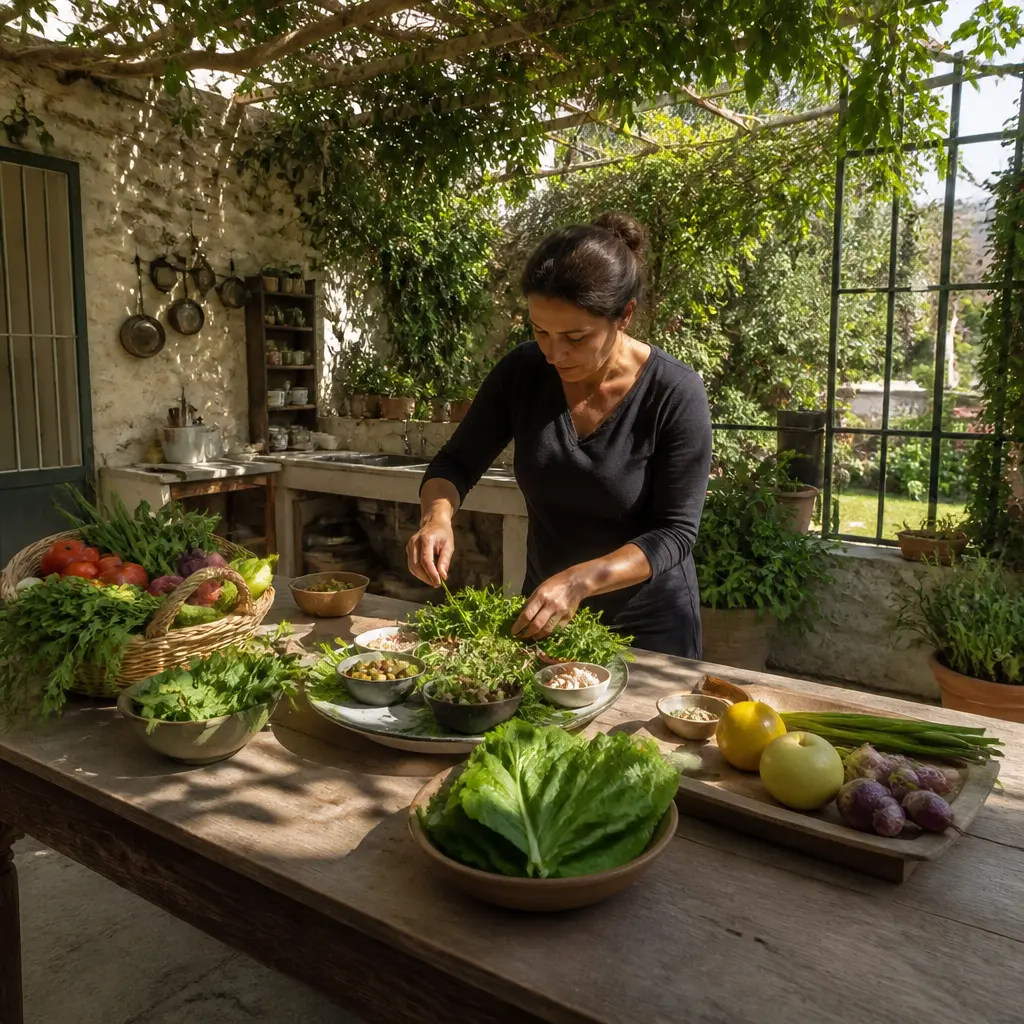
Fresh herbs are the tender, aromatic leaves and stems of plants such as parsley, mint, cilantro, dill, basil, and oregano. On a mezze platter, they act as flavor amplifiers: they add freshness, aroma, color, texture, and contrast to rich dips, grilled foods, pickles, and breads without requiring much oil, salt, or sugar. The best results come from matching each herb to a role—finishing, blending, garnishing, or balancing—and protecting its volatile aromas through careful washing, cutting, and storage. This matters because herbs are used in small portions but can substantially change perceived flavor; the USDA also identifies many fresh herbs as sources of vitamin K, vitamin C, provitamin A, and plant compounds, while the World Health Organization recommends at least 400 grams of fruits and vegetables daily as part of a healthy diet.
Fresh Herbs as Flavor Amplifiers on a Mezze Platter
A fresh herb flavor amplifier is an ingredient used to heighten aroma, sharpen contrast, and connect separate foods into a coherent meal. Culinary educators commonly distinguish between herbs used as a base, such as parsley in tabbouleh; herbs used as a finishing accent, such as mint on hummus; and herbs used as a balancing element, such as dill with salty feta or pickles. This attribute pairing is especially useful in mezze, a style of shared small plates that may combine creamy hummus, smoky baba ghanoush, briny olives, grilled meats, stuffed vegetables, and warm flatbread.
The key characteristic is aromatic intensity rather than bulk. A small handful of chopped parsley can make a dense dip taste brighter, while torn mint can make fried or grilled foods seem lighter. Fresh herbs also supply visual variation: deep green parsley, feathery dill, bright cilantro, and purple basil create a more inviting platter without additional decoration. The USDA FoodData Central database shows that herbs can be nutrient-dense by weight, although normal garnish portions are too small to replace vegetables or salads.
Parsley as a Freshness Base
Parsley is the most versatile foundation herb for mezze. Flat-leaf, or Italian, parsley has a stronger, more savory character than curly parsley and works particularly well in tabbouleh, chopped salads, lentil dishes, hummus, and grilled vegetables. Chop the leaves and tender stems finely, then fold them in shortly before serving so their green aroma remains vivid.
For a fast parsley relish, combine chopped parsley with lemon zest, lemon juice, olive oil, and a small pinch of salt. Spoon it over roasted eggplant, chicken kebabs, or warm pita. The acid supplies brightness, the oil carries aroma, and the herb creates a bridge between separate platter components. Parsley is also a useful correction when a dip tastes too rich or a grilled item needs a fresh counterpoint.
Mint as a Cooling Contrast
Mint is a cooling aromatic herb that contrasts with heat, fat, and char. Use it with lamb, kofta, yogurt sauces, cucumber, watermelon, roasted carrots, and spicy pepper relishes. Tear larger leaves rather than pulverizing them; tearing limits bruising and keeps the garnish visually distinct.
A mint-yogurt spoon sauce can be made by mixing Greek yogurt with chopped mint, grated cucumber, lemon juice, and a little garlic. Serve it beside spicy harissa, grilled meat, or roasted cauliflower. Mint should usually be added near the end because its delicate aroma fades quickly under prolonged heat. A few whole leaves scattered over the platter provide more fragrance than a dense mound hidden beneath other foods.
Cilantro as a Citrusy, Savory Accent
Cilantro contributes a bright, citrus-like flavor that pairs naturally with lemon, lime, chili, cumin, garlic, and coriander seed. It is particularly effective with ful medames, spicy bean dips, grilled shrimp, roasted squash, and North African-inspired salads. Chop the leaves and tender stems together for a fuller flavor, but discard thick lower stems that may remain fibrous.
Because cilantro has a strongly polarizing flavor profile, serve it as an optional finishing herb when feeding a group. A small bowl of cilantro, alongside parsley and mint, lets guests customize their bites. This is a practical example of a hyponym of the flavor-amplifier concept: the herb functions as a condiment-like accent rather than as the main salad ingredient.
Fresh Herbs as Texture and Aroma Builders
Beyond flavor, herbs create textural and aromatic layers. A mezze platter can include finely chopped herbs inside a dip, roughly torn leaves in a salad, and whole sprigs as edible garnish. Grouping herbs by cut and purpose prevents every component from tasting or looking the same.
Dill for Pickled and Creamy Foods
Dill is a feathery herb with a sweet, grassy aroma that complements cucumber, yogurt, potatoes, fish, beans, and pickled vegetables. Mix chopped dill into labneh, sprinkle it over beet dip, or pair it with quick-pickled onions. Its soft leaves are best added after cooking, since heat can flatten the fragrance.
Dill also helps connect acidic and creamy elements. For example, a platter containing labneh, olives, and pickled turnips can taste disjointed until dill is added to the labneh. The herb echoes the pickles while giving the dairy a lighter finish.
Oregano and Thyme for Robust Foods
Oregano and thyme are sturdier herbs with concentrated, savory aromas. They suit roasted tomatoes, grilled mushrooms, olives, feta, lamb, chicken, and white-bean spreads. Fresh oregano can be chopped into an olive-oil dip, while thyme leaves can be stripped from their stems and scattered over roasted vegetables.
Use these herbs more sparingly than parsley or mint. Their stronger essential oils can dominate delicate hummus or yogurt. A useful rule is to pair robust herbs with foods that have browning, acidity, or salinity; those characteristics give the herbs enough structure to remain balanced.
Basil for Sweet, Acidic, and Roasted Components
Basil is not traditional in every mezze spread, but it works well when the platter includes tomatoes, grilled peppers, eggplant, fresh cheese, or fruit. Use torn basil with tomato and feta, or blend it with olive oil and lemon into a bright sauce for grilled vegetables. Keep basil away from prolonged refrigeration when possible; cold temperatures can darken its leaves and weaken its aroma.
Fresh Herb Handling for a Better Mezze Platter
Wash, Dry, and Store Herbs Correctly
The U.S. Food and Drug Administration advises rinsing produce under running water and drying it with a clean towel; soap and produce washes are not recommended. Wash herbs shortly before preparation when practical, then dry them thoroughly. Excess water dilutes dressings and encourages wilting.
For tender herbs, wrap the stems loosely in a slightly damp paper towel and place them in a container or bag in the refrigerator. Basil is an exception: store it upright in a glass of water at room temperature and keep it away from cold drafts. Trimmed stems and clean water can extend its useful life and preserve its appearance for a serving platter.
Cut Herbs at the Right Moment
Sharp knives produce cleaner cuts than dull blades, which crush leaves and accelerate browning. Chop parsley, cilantro, and dill shortly before serving. Tear basil and mint by hand for a rustic finish, and leave a few leaves whole. If an herb is going into a hot dish, stir it in after the pan comes off the heat whenever food safety and the recipe allow.
Build a Three-Herb Mezze Finish
A reliable finishing combination is parsley for green savoriness, mint for cooling lift, and dill or cilantro for a distinctive aromatic note. Scatter the blend over hummus, labneh, roasted vegetables, and grilled proteins, but avoid covering every item equally. Place larger sprigs near the edges, chopped herbs over creamy dips, and an acidic herb relish beside richer foods.
For a practical case, arrange hummus, baba ghanoush, olives, cucumber, pita, and grilled chicken. Finish the hummus with parsley and olive oil, the eggplant with mint and lemon, the cucumber with dill yogurt, and the chicken with cilantro-parsley relish. Each herb has a defined job, yet repeated green notes make the platter feel unified.
Conclusion: Fresh Herbs as the Platter’s Unifying Element
Fresh herbs elevate mezze because they function as flavor amplifiers, texture builders, aromatic accents, and visual connectors. Parsley supplies a dependable freshness base; mint balances heat and richness; cilantro adds citrusy intensity; dill links creamy and pickled foods; and oregano, thyme, and basil support robust or roasted components. Careful washing, drying, cutting, storage, and timing preserve those benefits.
To improve your next platter, choose two or three herbs with different sensory roles rather than using one garnish everywhere. Taste each dip and grilled item, identify whether it needs freshness, cooling contrast, acidity, or savory depth, and add the herb that supplies that missing quality. Further reading from the USDA FoodData Central database and FDA produce-safety guidance can help connect culinary technique with informed ingredient handling.
Sources: U.S. Department of Agriculture, FoodData Central, https://fdc.nal.usda.gov/; U.S. Food and Drug Administration, Selecting and Serving Produce Safely, https://www.fda.gov/food/buy-store-serve-safe-food/selecting-and-serving-produce-safely; World Health Organization, Healthy Diet, https://www.who.int/news-room/fact-sheets/detail/healthy-diet; McGee, Harold, On Food and Cooking: The Science and Lore of the Kitchen, Scribner, https://www.simonandschuster.com/books/On-Food-and-Cooking/Harold-McGee/9780684800011.