

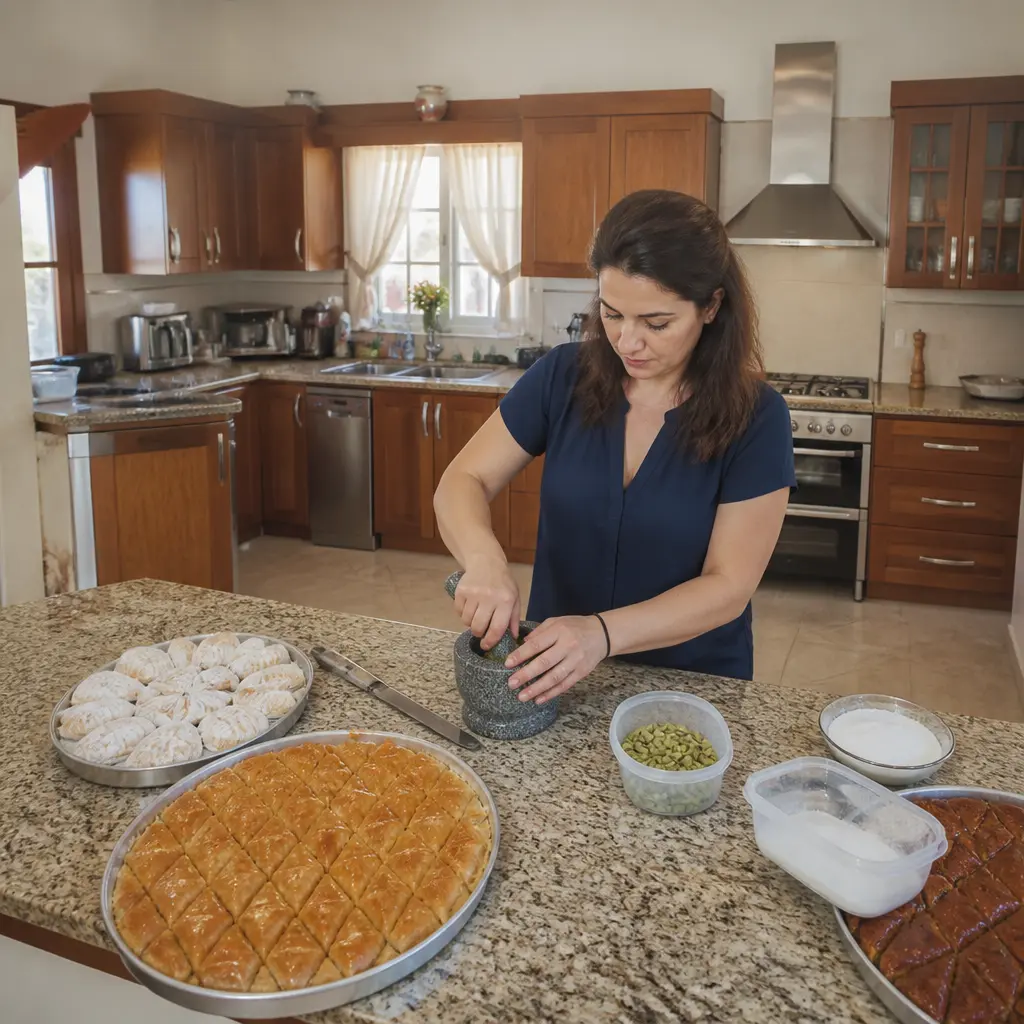
Cardamom’s aromatic accent is the spice’s ability to give ordinary sweets a concentrated floral, citrus-like, camphoraceous lift without making the dessert taste overtly savory. Green cardamom, the seed pod of Elettaria cardamomum, appears in ma’amoul, baklava, basbousa, qatayef, rice puddings, milk sweets, and coffee across the Middle East. Its intensity comes largely from volatile compounds such as 1,8-cineole and alpha-terpinyl acetate; its cultural importance is reinforced by centuries of trade linking South Asia, the Arabian Peninsula, the Levant, and the Mediterranean. Understanding dosage, preparation, regional pairing, and sugar balance reveals why a small amount can transform familiar sweets.
Cardamom Flavor Function: Cardamom–Aromatic Accent
The cardamom–aromatic accent is a culinary entity-attribute pairing that describes cardamom as a flavor modifier rather than the primary bulk ingredient. In practical terms, the entity is cardamom and the attribute is its capacity to add a high-impact aroma, fresh warmth, and lingering finish. Food writer and spice researcher Lior Lev Sercarz describes cardamom as a complex spice with both cooling and warming qualities, a combination that helps explain its versatility in sweet applications.
The pairing has several hyponyms: green-cardamom accent, black-cardamom accent, ground-cardamom accent, toasted-cardamom accent, and cardamom-water accent. Green cardamom is the standard choice for desserts because its aroma is bright and floral. Black cardamom is smokier and more resinous, so it is more often associated with savory dishes, though small amounts can create an unusual counterpoint in chocolate or date-based sweets. Ground cardamom disperses quickly through dough and syrup, while freshly crushed seeds release a sharper, more recognizable fragrance.
The McCormick Science Institute identifies 1,8-cineole and alpha-terpinyl acetate among cardamom’s important volatile constituents. Their proportions vary by cultivar, growing region, storage, and extraction method, so two jars labeled “cardamom” may produce noticeably different results. This variability is why cooks often judge cardamom by aroma instead of relying only on a fixed teaspoon measurement.
Green Cardamom: Floral Brightness
Green cardamom is the dried fruit pod of Elettaria cardamomum, usually opened or ground to expose its small black seeds. Its flavor combines citrus, eucalyptus-like freshness, peppery warmth, and a soft sweetness. In Middle Eastern sweets, the pod is commonly cracked and infused in syrup, milk, or coffee, while the seeds are ground into fillings and doughs.
The spice’s apparent “sweetness” does not mean it contains enough sugar to sweeten a recipe. Instead, its aroma changes how the palate interprets sweetness. A cardamom-scented syrup can taste more layered than an equivalent syrup flavored only with sugar and rose water. This is especially useful in desserts built from neutral ingredients such as semolina, rice, flour, cream, or clarified butter.
Whole Pod, Fresh Seed, and Ground Spice
Whole-pod cardamom is the most controlled form because cooks can remove the pods after infusion. Freshly crushed seeds provide a stronger and more complex aroma than pre-ground powder, which loses volatile compounds through exposure to air, heat, and light. Ground cardamom is convenient for ma’amoul dough, cake batter, and fillings, but it should be stored in a tightly sealed container and used relatively quickly.
A useful kitchen rule is to infuse whole pods when a clean background note is wanted and to use crushed seeds when the cardamom should be clearly identifiable. Toasting can intensify the spice, but excessive heat may flatten its fresh top notes. The United States Department of Agriculture’s FoodData Central database shows that cardamom is used in very small serving quantities, which means its culinary role is primarily aromatic rather than nutritional.
Cardamom Pairing Map: Cardamom–Sweetness Balance
The cardamom–sweetness balance is the relationship between cardamom’s aromatic intensity and the dessert’s sugar, dairy, grain, fruit, and fat components. Cardamom does not simply make a sweet dish “more cardamom-flavored”; it can make sweetness feel cleaner by introducing bitterness, coolness, citrus-like lift, and a lightly peppery finish.
Cardamom and Sugar Syrup
In baklava, basbousa, zalabya, and related syrup-soaked sweets, cardamom is often combined with lemon, rose water, orange blossom water, or cinnamon. These ingredients perform different sensory tasks. Sugar supplies body and sweetness, lemon offsets heaviness, floral waters provide perfume, and cardamom adds a more structured aromatic middle note.
Adding cardamom directly to a hot syrup extracts its aroma efficiently, but boiling it for too long can produce a flatter profile. A practical method is to simmer lightly with cracked pods, turn off the heat, and allow the syrup to steep before straining. In richer pastries, a restrained cardamom infusion can prevent the syrup from tasting one-dimensionally sugary.
Cardamom, Dairy, and Rice
Milk puddings such as muhallabieh, rice pudding, and regional variations of milk-based custards use cardamom because dairy softens its sharper edges. The spice’s eucalyptus-like freshness keeps cream, milk, and starch from tasting heavy, while the dessert’s fat carries its oil-soluble aromas.
Cardamom is also compatible with yogurt, labneh-based preparations, cream, and soft cheeses. In these combinations, it works particularly well with pistachio, almond, date, fig, and apricot. The result is a layered flavor sequence: creamy or nutty at first, aromatic in the middle, and lightly peppery at the finish.
Cardamom, Nuts, and Dried Fruit
Pistachio and cardamom form one of the most recognizable pairings in the region, appearing in baklava, ma’amoul fillings, halva variations, cookies, and modern pastries. Almond and walnut offer more neutral or earthy foundations, allowing cardamom to become more prominent. Dates and figs contribute caramel-like fruitiness, which makes cardamom taste warmer and more rounded.
Rose water and orange blossom water are frequent partners, but they should not be treated as interchangeable. Rose water adds a deep, powdery floral note; orange blossom water is brighter and more citrus-like. Cardamom can bridge the two, although using all three heavily may produce an overly perfumed dessert. The strongest recipes usually assign one ingredient the lead and use the others as accents.
Cardamom in Everyday Middle Eastern Sweets: Cardamom–Regional Tradition
The cardamom–regional tradition pairing connects a spice’s flavor function with the occasions, ingredients, and techniques of a particular food culture. Cardamom is not exclusive to one national cuisine; its use differs across the Levant, Arabian Peninsula, Iraq, Egypt, Turkey, and Iran. The same spice may be ground into a cookie, infused into a pudding, added to coffee, or incorporated into a celebratory pastry.
Ma’amoul: Cardamom in Shortcrust and Filling
Ma’amoul is a molded semolina or flour cookie commonly filled with dates, walnuts, pistachios, or almonds. Cardamom may be added to the dough, the nut filling, or both. In date ma’amoul, it counters the fruit’s dense caramel character; in pistachio ma’amoul, it emphasizes the nut’s green, resinous quality.
The spice is especially effective here because the cookie contains contrasting textures and aromas: crumbly dough, concentrated fruit or nuts, and sometimes orange blossom or rose water. Cardamom ties these components together without requiring a thick glaze or elaborate decoration.
Baklava and Basbousa: Cardamom in Syrup-Soaked Pastries
Baklava traditionally relies on layers of pastry, butter or clarified butter, nuts, and syrup. Cardamom can appear in the nut mixture or in the finishing syrup, where it gives the dessert a fresher finish. Basbousa, a semolina cake soaked in syrup, benefits from the same strategy: cardamom adds fragrance to a dense, moist crumb while lemon or citrus prevents the profile from becoming cloying.
Because these desserts are already rich and sweet, dosage matters. A small quantity of freshly ground cardamom can be more effective than a large quantity of stale powder. The World Health Organization recommends limiting free sugars to less than 10 percent of total daily energy intake, with additional benefits associated with staying below 5 percent. Aromatic spices cannot make a high-sugar dessert nutritionally light, but they can help cooks pursue intensity through flavor complexity rather than additional sugar.
Qatayef, Kunafa, and Filled Pastries
Qatayef and kunafa vary widely by region and household, but both demonstrate how cardamom can operate across dough, filling, syrup, and garnish. In qatayef, it may support a walnut or cheese filling; in kunafa, it can brighten the combination of shredded pastry, soft cheese, butter, and syrup. Cardamom is often most successful when used in only one or two components, preserving contrast between the pastry, filling, and topping.
These desserts also show why culinary traditions should not be reduced to a single “authentic” formula. Recipes differ by city, season, family, and available ingredients. A cardamom-scented syrup may be customary in one household and absent in another, while both versions remain culturally recognizable.
Cardamom Coffee and the Dessert Table
Arabic coffee, often prepared with cardamom, provides an important context for understanding the spice’s role in sweets. The coffee’s bitterness and roasted aroma make cardamom’s cooling, floral qualities especially apparent. Serving cardamom coffee with dates, ma’amoul, or nut pastries creates a deliberate contrast between bitter beverage, aromatic spice, concentrated fruit, and sugar.
This pairing also explains why cardamom can taste familiar even when it is not visibly present in a dessert. Diners may recognize the spice from coffee, tea, or savory rice dishes and perceive it as part of a broader hospitality vocabulary rather than as an isolated pastry ingredient.
Cardamom Technique: Cardamom–Aroma Preservation
The cardamom–aroma preservation pairing describes the relationship between preparation technique and the survival of volatile flavor compounds. Cardamom’s most delicate notes are easily lost through prolonged exposure to heat and air, so grinding, infusing, storing, and timing all affect the finished dessert.
Crush at the Right Moment
Crushing pods shortly before use releases aromatic oils while limiting oxidation. For a mild flavor, crack the pods and steep them in milk or syrup. For a pronounced flavor, remove the husks and grind the seeds with a mortar and pestle. A fine powder distributes evenly, but a slightly coarse grind can create occasional aromatic bursts in a cookie or nut filling.
Use Heat as an Extractor, Not a Destroyer
Moderate heat extracts cardamom into fats and liquids, while prolonged high heat can diminish its brightest notes. Infusing pods in warm milk, butter, or syrup is therefore more controlled than baking a large amount of powder at high temperature. When cardamom is added to a baked dough, a small portion can be reserved for the finishing syrup or glaze to restore freshness.
Taste Against the Complete Dessert
Cardamom should be evaluated after the dessert is assembled, not only in the raw batter. Sugar, butter, dairy, nuts, and syrup alter aroma perception. A mixture that seems intensely spiced before baking may taste balanced afterward, while a delicate batter may become overwhelming once concentrated by evaporation.
For home cooks, a reliable progression is to begin with one or two freshly crushed pods for a small batch of syrup or a modest quantity of filling, taste after infusion, and increase gradually. This approach is safer than correcting an over-spiced mixture, since excessive cardamom can become medicinal, bitter, or aggressively camphoraceous.
Cardamom’s Broader Significance: Cardamom–Cultural Continuity
The cardamom–cultural continuity pairing reflects how ingredients preserve connections among trade, hospitality, memory, and domestic practice. Cardamom originated in the forests of southern India and Sri Lanka and became part of long-distance spice commerce. The Food and Agriculture Organization identifies India and Guatemala among major cardamom-producing countries, illustrating the distance between cultivation zones and the many cuisines that use the spice.
In Middle Eastern foodways, cardamom’s presence in coffee and sweets often signals welcome, festivity, and generosity. Its use in everyday puddings and cookies is equally important: cultural continuity is maintained not only in ceremonial dishes but also in repeated household acts such as grinding spices, filling pastry molds, and steeping a syrup after dinner.
A useful text-based flavor chart would place cardamom at the intersection of floral, citrus-like, minty, peppery, and resinous notes. Around it would sit compatible ingredients such as pistachio, almond, date, rose, orange blossom, lemon, coffee, milk, and clarified butter. The chart would also show caution zones: excessive pairing with strong floral waters, too much black cardamom, or prolonged boiling can obscure the dessert’s intended balance.
Conclusion: Cardamom–Aromatic Accent in Context
Cardamom’s aromatic accent explains why a few crushed seeds can reshape ma’amoul, baklava, basbousa, qatayef, kunafa, rice pudding, and milk-based sweets. Its green-cardamom brightness complements sugar, dairy, nuts, dates, citrus, rose, and orange blossom, while preparation choices determine whether the final flavor is delicate, vivid, or overpowering. The cardamom–sweetness balance shows how aroma can create complexity without simply adding more sugar, and the cardamom–regional tradition pairing connects dessert technique with hospitality and cultural memory.
To explore the spice further, compare whole pods with pre-ground cardamom, infuse it in a syrup and a milk pudding, and taste each version alongside pistachio, dates, or coffee. Reading regional cookbooks and producer information can deepen that experiment by showing how the same aromatic accent changes across communities, cultivars, and generations.
Sources: Encyclopaedia Britannica, “Cardamom,” https://www.britannica.com/plant/cardamom; McCormick Science Institute, “Cardamom,” https://www.mccormickscienceinstitute.com/resources/culinary-spices/cardamom; U.S. Department of Agriculture, FoodData Central, https://fdc.nal.usda.gov/; Food and Agriculture Organization of the United Nations, FAOSTAT, https://www.fao.org/faostat/en/; World Health Organization, Guideline: Sugars Intake for Adults and Children, https://www.who.int/publications/i/item/9789241549028; Sercarz, Lior Lev, The Spice Companion, Clarkson Potter, 2016, https://www.penguinrandomhouse.com/books/535040/the-spice-companion-by-lior-lev-sercarz/